What happens at the Big House

Chris Wormly dominates in highschool (Exclusive video Everything Michigan and More)

Showing posts with label Denard Robinson. Show all posts

Monday, September 26, 2011

Denard Robinson B1G Ten Offensive Player Of The Week...Again


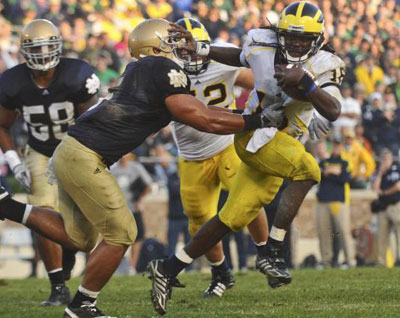
After piling up 293 total yards of offense last Saturday against the then undefeated San Diego State Azteks, Denard Robinson has been named Big Ten Offensive Player of the Week for the second time this season. Denard earned his first Big Ten Offensive Player of the Week honors after the comeback victory against Notre Dame in the Under the Lights game earlier this month.

Although Denard shared the award this week with Penn State quarterback Matt McGloin, it is quite impressive to be awarded this honor twice in just four weeks of game play. Denard certainly has suffered much criticism (detailed post on Denard as a quarterback: here), but since he has the highest average yards per game (NCAA doesn't count the Western game) he is sure to win some awards.

I anticipate Denard will have a tougher time winning this award down the stretch this season with some tougher defenses on the schedule, but clearly last season's Big Ten Offensive Player of the Year has utilized his talents this season.

Sunday, September 25, 2011

Michigan Doesn't Have A Quarterback


If you've been following Michigan's 2011 season or read any newspaper or fan articles, you would probably have realized there is a lot disdain regarding Denard Robinson's throwing abilities. In fact, at Michigan's last home game against San Diego State, I overheard several fans commenting on how Devin Gardner (Michigan's backup quarterback) should be thrust into the game because Michigan "doesn't have a quarterback, just a running back."

Now, I think most fans realize qb controversies and criticisms are nothing new (I actually posted a 3 part series on Denard Robinson as a qb: here), but the amount of negative criticism from both the media and Michigan "fans" (you have to question their "fan" status if they spend 4 quarters criticizing everything Michigan does) has reached a new all-time high against Denard after 4 "lackluster" games.

So, if we believe this criticism what should we think? Well, Denard has good rushing ability, but he can do NOTHING against good competition and has almost no passing ability. He also cannot last the length of a season because the rushing breaks him down physically. Now, I addressed most of these points in my Denard QB series (located here), but that was pre-season, I think that since roughly 1/3 of the season is over and the anti-Denard folks have taken over, it's appropriate to take a new analysis of his performance.

So, first let's take a quick look at his stats for 2011:

Denard Robinson
35 of 72 passes completed
48.6% completion percentage
624 passing yards
8.67 yards per attempt
6 passing tds
6 interceptions

71 rushing attempts
552 rushing yards
7.8 yards per rush
5 rushing tds

At first glance, the rushing statistics are phenomenal, but the passing seems to be a little underwhelming. Completing less than half his passes and turns it over as much as he scores through the air? Wow....that's not a good sign. However, as I noted last summer and will repeat now, going off simple stats like this is NOT the best method for determining success either on the ground or through the air. It doesn't adjust for opponent difficulty, receiver failure, or luck.

Now, it may sound like I'm making excuses, but let's take a quick look at his "horrible" completion percentage. If a quarterback completes less than half his throws he must be doing bad, right? Well....not always. Arguably, the biggest factor this season in Denard's completion percentage has been his low number of passing attempts.

Theoretically, this should have no impact on Denard's completion percentage, but as we all know, that doesn't always work in real life. The reason is because there are so many factors impacting just one completion. Offensive blocking, defensive pressure, catching by the receiver, defensive coverage, and finally the quarterback's reads and throw. For example, in the game against San Diego State, Denard made a perfect pass to Koger, but it bounced right off his hands and resulted in an incompletion. Should Denard be blamed for this? Well of course not, he didn't drop the pass, but if you simply look at the stats, you don't realize this statistical problem.

This is even more important this season for Denard beccause he has been attempting such a low number of passes. I'll just use the Notre Dame game, since they are probably Michigan's best non-conference opponent. Denard attempted 24 passes (his only game this season with at least 20 attempts). However, in Michigan State's game against Notre Dame, Kirk Cousins attempted 53 passes. Cousins and Denard are not the best quarterbacks to compare, especially in varying game situations, but Cousins still attempted more than DOUBLE the amount of passes as Denard.

However, an even better comparison is Denard 2010 and Denard 2011 against Notre Dame. In 2010, Denard had his best game of the season against Notre Dame and attempted 40 passes. This means that against the same team a year later, Denard attempted 16 fewer passes. As I said earlier, this shouldn't impact percentage, but there's no doubt that any potential mistake either from Denard or a receiver would be much more significant with fewer passing attempts. An incompletion against Notre Dame last season would have lowered his completion percentage by just 2.5%, but this season an incompletion would have lowered it 4.2%. Clearly, this makes any one mistake much more important statistically.

So Denard's completion percentage isn't a good indicator this season, but what about his touchdown to interception ratio? He has 6 tds and 6 ints, certainly this shows that he doesn't have passing ability. However, as I pointed out last summer, this is not a good stat to use when analyzing Denard. It may work for most quarterbacks, but most quarterbacks typically don't score on the ground. If you've watched Michigan, you know that many times they will opt to run Denard in the red-zone instead of going to the air just because it's more effective.

For instance, Kirk Cousins currently has a +3 ratio, meaning he scored 3 more touchdowns than interceptions. Denard would be at 0, but if you include his rushing touchdowns he ends up at a +5 ratio. Although this is not the best quarterback comparison, it does illustrate that just because Denard uses a different method to score doesn't mean it's ineffective.

So if completion percentage and td/int ratio aren't good indicators, how is Denard doing this season? Well, first, let's not forget the team is 4-0 right now. It's hard to justify switching anything, if everything has gone well to this point. Along with that, let's not forget that against Michigan's toughest non-conference opponent this season, Notre Dame, Denard won Player of the Week honors and led the team to a comeback victory, relying much on the passing game (ended with a 193.3 qb rating for the Notre Dame game).

I can't sit here and claim Denard has NFL talent passing abilities or is the next Tom Brady or Peyton Manning, but what I can say is that the anti-Denard folks have certainly been basing a lot of their claims and solutions (Devin Gardner has NEVER started a collegiate game) on questionable data.

Along with that, there seems to be this perception against rushing quarterbacks. For some reason if Denard had more passing yards than rushing it means he's a good quarterback. As far as I'm concerned, 293 total offensive yards is still 293 total offensive yards. Until it's proven that passing yards counts more than rushing, I don't see the difference.

Denard will need to improve this season, particularly passing, but let's not jump on the anti-Denard bandwagon. He's still the defending Big Ten Offensive Player of the Year who is averaging 294 total yards a game. Along with this, he has yet to leave a game because of injury (hopefully it stays this way...please!) after 4 games when he left for significant periods in almost all the first 4 games last year. I've always enjoyed watching Denard and have learned to never doubt his abilities. I say go get 'em Shoelace.


Full Summer Denard QB Series:

Part I: "Sure He Can Run, But When He Has to Throw He Can't Do Anything"
Part II: "He Can Play Well Until He Hits The Red Zone"
Part III: "You Looked Good For Five Games Against Nobody"

Monday, September 12, 2011

Denard Robinson B1G Ten Offensive Player Of The Week


Although Denard Robinson threw 3 interceptions in Saturday's Under the Lights game against Notre Dame and completed only 11 passes, he was selected as the Big Ten Offensive Player of the Week reports the Detroit Free Press this morning.

Though Robinson's statistics may not look superb, his fourth quarter play was very impressive. He led Michigan to 28 points in the fourth quarter for the second-biggest comeback in stadium history (17 points).

Denard ended up accounting for 446 total offensive yards (338 passing and 108 rushing), meaning that Denard was involved in almost 98.7% of all the offensive yardage. Along with this Denard ended up with 5 total touchdowns (4 passing and 1 rushing) which was Michigan's total touchdowns for the night.

Even although Denard's overall stats were not that impressive, his ability to contribute to every Michigan touchdown and 98.7% of the team's offensive yards allowed him to receive this distinct honor this week.

This is Denard's 4th Big Ten Offensive Player of the Week award and the team's first since November 8th, 2010 when Roy Roundree won the award after the team's amazing win against Illinois in triple overtime.

Denard and Michigan both still need to improve to have a chance at larger goals for this season, but it's nice to have two Big Ten players of the week after the first 2 weeks of the season (Brandon Herron was named Big Ten Defensive Player of the Week last week. Read: here).

Monday, August 29, 2011

Denard Robinson An Early Heisman Favorite


If you've been following the mass of preseason rankings and predictions, you would have seen the large amount of love the media has been giving Michigan quarterback Denard Robinson. Though he was selected Big Ten Offensive Player of the Year for 2010, he has received much scruntity from fans and select media outlets (See: Denard Robinson QB Series).

However, this year's preseason rankings have left those critics to reassess their theories. Not only has Rivals rated Denard very high on its lists, ESPN's Big Ten Blog has placed Denard at the top of many of its rating lists. Here are some of the rankings:

Denard Robinson Preseason Rankings:


However, Denard now appears at the top of one of the most prestigous lists in college football, the Heisman race. Though he finished 6th in last year's Heisman voting and as an All-American, he has not received much coverage as a potential winner of this year's Heisman trophy.

In Rivals' preseason Heisman ranking, Denard Robinson was picked at #4. It seems as if he would have been higher, but they questioned whether he could put up his amazing 328.6 total offensive yards per game under a new offense.

Though this lists hardly picks Heisman winners, (Cam Newton, the 2011 Heisman winner received almost no attention during preseason) it is still exciting for fans and shows that the "experts" and media can see some of Denard's great talent.

Sunday, August 28, 2011

Shoelace Ranked #1 Most Explosive Player in Nation By Rivals!!

Rivals released their top-ten list of what they believe are the most explosive players in the nation. Guess who was number one? A kid we like to call Shoelace in Ann Arbor!

Rivals described Denard as follows:

"Robinson is like a time bomb: Sooner or later, he's going to explode. Each time Robinson tucks the football, opposing fans hold their breath because he always seems one step away from making a big play. Last season, his first as a full-time starter in former coach Rich Rodriguez's spread offense, Robinson had 16 runs that covered at least 20 yards and seven that exceeded 30 yards. He had at least one 20-yard gain in nine of the Wolverines' 13 games last season. He scored touchdowns on runs of 87, 72, 47, 32 and 32 yards. He also had 12 pass completions of more than 40 yards. That's more than Stanford's Andrew Luck. A big question with Robinson is how the new Michigan staff will make use of his talents."

This is a huge honor for Denard, being on top of a list that features awesome talent with the likes of Trent Richardson (RB, Alabama, #10 on list), LaMichael James (RB, Oregon, #3 on list) and Justin Blackmon (WR, Oklahoma State, #2 on list).

Let's hope Denard can live up to all the hype!

Friday, August 26, 2011

Denard Robinson Ranked #2 Player in Big Ten By ESPN


Earlier this week, I posted about the positive reviews many Big Ten teams, and particularly Michigan, have been receiving from the media. For the earlier post about Rivals and ESPN's Big Ten rankings you can go here:


Now, back to Denard Robinson. He was primarily selected off "past performance and potential impact in 2011." Clearly, Denard Robinson had an a-maize-ing 2010. He set numerous records including most rushing yards for a quarterback in the FBS history.

There is no doubt that much of Michigan's improvement in 2010 can be linked to Robinson's emergence as the starting quarterback. For instance, in a tight contest against Notre Dame, his 502 total yards, yes I said 502 total yards, took control of the game and turned the tide for the maize and blue.

He was an early Heisman favorite and although his performance slipped in some of the later games in the season, he still performed well finishing at 6th in the Heisman voting. We look forward to some great things from Denard in 2011 and perhaps he can move up to the #1 spot for 2012!

For ESPN's review of Denard, click here:


Also, we had a great earlier series capturing Denard's performance as quarterback last season and addressing whether he really should be considered a legitimate quarterback:


Monday, August 22, 2011

Rival's Preseason Rankings Favor Big Ten and Michigan


Though preseason rankings and predictions are often far off from the actual results, they still make for interesting reads and some great "water cooler" discussions.

In one of Rivals' most expansive preseason rankings list, the Top 100 Players Countdown, several Michigan players received some praise from the website:

Rivals' Preseason Top 100 Players:

Denard Robinson - #20
Mike Martin - #47
David Molk - #75

ESPN's Big Ten Blog has also picked several Michigan players in its Top 25 Big Ten Players. Though the full list is not out yet, Denard Robinson has not yet been listed, several have already been named.

ESPN's Top 25 Big Ten Players:

David Molk - #12
Mike Martin - #10

Another set of preseason rankings by Rivals placed Mike Martin as the #3 defensive tackle in the nation trailing only Billy Winn of Boise State and Jared Crick of Nebraska. This is a pretty significant ranking since there has been much preseason hype for players like Jerel Worthy (ranked #8) from Michigan State and John Simon of Ohio State (ranked #6).

Though Michigan would like to see more players on these lists in the coming years, it's awesome to see these types of rankings with such a young team. The Big Ten did well overall with 21 players ranked in the Top 100 overall players and 4 defensive tackles ranked in the top 15 in the nation.

Here are the full rankings:


Sunday, August 21, 2011

Michigan Football Preview - Big Ten Network


Tomorrow night, the Big Ten Networks's preseason tour rolls through Ann Arbor and will be analyzing the Wolverines and their chances for the 2011 season. The broadcast will begin @ 8pm and runs a half hour.

The show includes former Big Ten coaches and interviews with Wolverine coaches and players. From a tweet by Gerry DiNardo, or @gerrydinardo, Denard Robinson should be interviewed about how he feels about the new offensive scheme, coaching transition, and the upcoming season.

Though some feel the broadcasters are "mellow" and "bland," there is sure to be some live practice footage and interviews with current players and the coaching staff, so I don't see much to complain about. It isn't often that national television devotes an entire broadcast to Michigan's 2011 season.

So remember to get home to watch the broadcast and hopefully view some interesting commentary, interviews, and practice footage. If nothing else, the broadcast provides a nice transition from summer to football season.

Let's hope they have positive comments!

Tuesday, August 16, 2011

Exclusive video from Fan Day and our kicking game!


Sorry everyone for not posting anything sooner. I have been working on this video since I got back from Ann Arbor. I hope you enjoy it. Please make sure you watch all of this video because I'll bring you up close with the Michigan Kickers and Brady Hoke! This video is Hot! You can't get much closer to the action! Thanks to Coach Hoke for some great clips!  GO BLUE!

Watch the uncut Matt Wile video http://t.co/TxPU13K


Monday, August 1, 2011

"You Looked Fantastic For Five Games Against Nobody"


Part III

Well, this is the final piece of my epic (or just extremely long) analysis of Denard Robinson and his quarterback play. Part I focused on his throwing ability, Part II focused on his ability to score in the red zone, and Part III is an analysis of Denard's success against "good" teams.

Before I get into my analysis of Denard against "good" teams, I'd like to briefly address why I've went into such depth about one player . Though his popularity with the fan base may seem to validate the length of my post, I chose to analyze Denard's performance in such length because he is perhaps the most important player on the current roster. Not only because of his talents and success last season, but because of the key role he plays in the transition from Rich Rodriguez to Brady Hoke.

As we all know, Rodriguez ran a unique spread-based offense while Brady Hoke and Al Borges operate primarily out of west coast schemes (for those of you not familiar with football schemes, imagine going from the English to the Metric system). This means the offense will be going through some big changes before next season and that there is a tremendous amount of pressure on Denard Robinson to perform well because of his large role on the team (led the team in yards last season).

So now that there is at least a little understanding of my analysis, let's go right into Part III; Denard's performance against "good" teams. If any of you have been following the off season football news, or lack thereof, you likely noticed a quote from Desmond Howard speaking about Denard's performance and relevance to Michigan's football program. Though his statement was not meant to tear down Denard, but to address issues in the NCAA, I felt that his quote was an accurate representation of much of the public sentiment about Denard's alleged failure against "good" teams.

In order to address these allegations, one first has to determine the content of the allegations. So, who are the "good" teams? As the quotation marks signal, this is always debateable. Technically, you could consider almost any team to be "good" in some aspect, but this is hardly the approach I'd like to use for my analysis. Instead, I'm using a statistic developed that attempts to avoid simple win - loss records or raw yardage stats. Football Outsiders using a stat called FEI, which takes many things into account such as schedule difficulty, field position, special teams play, and other game factors that win - loss records and raw yardage stats don't include. I went through their ranking list of the 2010 season in hopes to determine who were the "good" teams.

I decided that I would call any teams ranked higher than Michigan to be considered "good" under my criteria. Though some may not call Michigan a "good" team last season, they were at least average, so any team above them has to be at least average or above-average. The rankings listed eight teams on Michigan's 2010 schedule that were above Michigan.

2010 Teams Ranked Above Michigan by Football Outsiders:

Ohio State #8
Wisconsin #12
Iowa #21
Notre Dame #23
Mississippi State #27
Illinois #35
Michigan State #39
Connecticut #49

Though these rankings may seem odd since Michigan actually beat three teams above them in the rankings, it is a guideline for how the teams performed over the entire season taking circumstances into account, not on one specific Saturday. For instance, Michigan State was ranked below several teams it defeated on the 2010 schedule as well, but this is because they relied upon a more forgiving schedule, close games, and trick plays to have success in 2010, which takes away from their ranking because their performance was not as convincing.

So now that we have a rough analysis of the "good" teams Michigan faced in 2010, let's look at how Denard fared against these teams. Though Denard had his "ups and downs" against these teams, if you take a full analysis of all eight games, Denard was actually a pretty competent quarterback. Here are the stats:

Denard Robinson Through Eight Games Against "Good" Teams:

62.9% completition percentage
203.25 passing yards per game
1.38 passing touchdowns per game
1 interception per game
124.13 rushing yards per game
.88 rushing touchdowns per game

The first interesting thing is his production as a passer. Though many question his passing abilities, Denard was actually a pretty competent passer (See Part I for a more in-depth analysis of Denard's passing). He is far from perfect, but when you have a positive turnover ratio, make over 60% of your passes and also add significantly as a runner, it seems to be a stretch to claim Denard can do nothing against quality competition.

In fact, if we adjusted these stats using MGoBlog's analysis system (discussed in Part I ; judge passes based on quality, not on completion) Denard may actually have better numbers! For instance, Denard had a 64% completion percentage against Wisconsin, but if one usedMGoBlog's rating system, Denard actually improves to a 71% completion rate, which is a great passing day. Though these stats do nothing to improve Michigan's record, but they should be taken into account if people are wrongly criticizing a player.

So, in conclusion, I've had a great time writing these three posts and I've hoped you all enjoyed them. I think after reading them, most of the mindless rambling about Denard's inability to throw, operate in the red zone, and compete against quality competition can be thrown out the window. Sure, he is a far from perfect player, but there's no use mindlessly driving a very nice guy into the ground because he made some mistakes in a football game. The guy is a class act. I mean, imagine replacing him with a player like Terrell Pryor. I think we got very lucky to have a great guy like Denard.

I can't wait for Denard's next epic season and guess what?

I'll have my shoes untied the entire time,

Thursday, July 28, 2011

Big Ten Media Day


Today was the largest summer event for Big Ten Football. All the coaches were allowed to give a speech and held a question and answer session with the media. Some highlights of Brady Hoke's speech and the question & answer session:

Hoke talked about the special rivalry between Michigan and Ohio State and said you're not human if you aren't hyped for that game.

The coaching staff is smart enough to incorporate some spread features into the offense next season to fully maximize the players and specifically Denard Robinson.

He's looking forward to fall camp and sees it as the best place for developing this team.

Hoke talked about how this is and always will be a senior-lead team.

Michigan is not rebuilding. He feels that Michigan has enough pieces in place to be great.

No decision on Stonum at this point and his status with the team.

On recruiting success, he simply stated that, "We're Michigan." He sees the school's reputation doing as much work as him and his staff, but he admits his staff has been very active.

He says team is looking forward to the Under the Lights showdown with Notre Dame on September 10th, but wants to keep the focus on September 3rd game against Western at this point.

For the full video:

Friday, July 22, 2011

"He Can Play Well Until He Hits the Red Zone"


Part II

Well, I rambled a bit in the last post, so I'm going to try and keep Part II of my analysis of Denard Robinson's quarterbacking a bit more concise. Since I think analyzing the quarterback on any team is a difficult task, I'm dividing this into three pieces. Part I focused on his throwing ability, Part II will focus on his ability to score in the red zone, and Part III is an analysis of Denard's success against "good" teams.

So when determing Denard's ability to score in the red zone it would make sense to look at Michigan's offensive stats from last season. Michigan had the most offensive yards of any Big Ten last year, but seemed dropped off a little in actual scoring. Michigan had the 3rd best scoring offense and the worst red zone success rate in the Big Ten. So with a quick glance, anybody looking at these stats can see Michigan could move the ball, but they seemed to have quite a bit of trouble in actually putting points on the board when it counted.

So Michigan's 2010 red zone offense seemed to leave much to be desired, but before we place all the blame on Denard, let's take a look at the team's scheme. Is this failure to convert in the red zone something that can be linked to Rich Rodriguez's offenses, or is this more correlated with Denard Robinson? Well, with a look at West Virginia's offensive statistics, it can be seen that Michigan's poor red zone scoring offense cannot be linked to Rich Rod's schemes. Rich Rod's teams at West Virginia boasted red zone success rates near 90%, much higher than Michigan's 78% in 2010.

So what was the difference between Michigan's 2010 offense and Rich Rodriguez's West Virginia teams? What could possibly have caused a 12% drop in red zone success when players are using the same schemes? The easiest way to explain this drop seems to be to point at the quarterback, Denard Robinson. If you look at Denard's stats, he only passed for 7 more touchdowns than interceptions and seemed to struggle at points in the red zone. Denard's inability to throw these touchdowns seems the most obvious cause of the drop off from Rich Rod's earlier teams.

However, with a little more analysis, this doesn't seem to add up. In fact, in 2006, Pat White's stats ended up being almost identical to Denard's passing stats. Pat White threw just 6 more touchdowns than interceptions (5 fewer total touchdowns than Denard), had a 65.9% completion percentage (3.4% higher than Denard), and had 1655 yards (about 900 less than Denard).

So what this tells us is that Pat White was not that much better of a passer than Denard in 2006. So if Denard performed near the same level as West Virginia's quarterback, then what caused the 12% drop off? I point, not to Denard Robinson as the cause of Michigan's poor red zone success last season, though some is surely his fault, but to Michigan's running backs.

Although Denard made a significant impact as a runner as well as a passer, this cannot discount Michigan's poor performance at running back. This is because Pat White was almost, or just as good or a runner as Denard. In 2006, the season where West Virginia had an almost 90% red zone success rate, Pat White ended up with 18 touchdowns (4 more than Denard) and over 1200 yards (500 less than Denard).

However, West Virginia's 2006 offense had another rushing threat to complement White which Michigan lacked in 2010. Not only did Pat White put up amazing numbers as a quarterback, but Steve Slaton did some great things as a running back. He scored 16 touchdowns (9 more than the highest Michigan running back) and ran for over 1700 yards (almost 1100 more than Michigan's highest running back).

So what we can say based on this data is that Slaton had much more success than any single Michigan running back. However, anyone who watched last season knows that Michigan used several running backs. So what I did was add together the top 3 running backs on both West Virginia and Michigan for touchdowns and yards. West Virginia top 3 running backs ended up with 8 more touchdowns and over 1100 more yards than the top 3 running backs from Michigan.

Bottom line, West Virginia's performance from its running backs was far superior to the performance of Michigan's running backs. Though running backs shouldn't be accountable for all the offensive production, they are vitally important in the red zone. With a strong running back attack like that West Virginia, Michigan's red zone numbers would surely have improved. Since Michigan already scored more passing touchdowns than West Virginia, closing the gap for rushing would have been an enormous improvement.

So the data seems to show that Denard shouldn't be blamed for most of Michigan's red zone woes, but let's take a look at his turnover margin. Since red zone success is determined by scoring, let's take a glance at Denard's scoring numbers. Denard ended up with 18 passing touchdowns, but threw 11 interceptions. Though this was a massive improvement from 2009 (See Part I on Denard), this still appears to be a place for improvement. A +7 td/int ratio is not anything to brag about seeing that almost all the other Big Ten quarterbacks had a higher ratio.

However, there's one glaring omission from this ratio. Denard Robinson had almost as many rushing touchdowns as passing touchdowns. For example, Kirk Cousins had a +10 td/int ratio, but only had 1 rushing touchdown. If you add this, he ends up with a +11 td/int ratio. However, if you add Denard's rushing touchdowns to his ratio, he ends up having a +21 td/int ratio. Though this isn't exactly a perfect statistic, it's important to realize that his passing touchdowns numbers most likely were decreased from his frequent use of his legs to score.

Is Denard a perfect red zone quarterback? Of course not, but simply blaming Michigan's poor red zone success on him is not right either. In fact, Michigan's red zone success actually IMPROVED in 2010 with Denard Robinson in the quarterback position. With an analysis of West Virginia's offensive numbers, it can be seen that Michigan's poor running back success most likely had much more to do with Michigan's poor red zone success than anything Denard did or didn't do last season. Along with this, simply pointing at his +7 td/int ratio can't be seen a proof he "can't" play well in the red zone because it ignores his success as a runner.

I can't wait for Part III and make sure to follow me on Twitter:

Tuesday, July 12, 2011

"Sure, he can run, but when he has to throw, he can't do anything"


Part I

Last weekend, when speaking with several friends, I was astounded by the lack of faith in Denard Robinson's abilities at the quarterback position. Though it's quite common for a quarterback to receive scrutiny from fans, it baffled me that people would blame one of the few players with a productive 2010 season.

The biggest criticisms of Denard seemed to rest upon his "inability" to throw accurate passes, "failure" to convert in the red-zone, and inability to compete against "good" teams. Though there is probably some elements of truth in each one of these criticisms, I'd like to analyze whether these criticisms actually hold real significance. I'm dividing my analysis into 3 sections, with the first focusing on his passing abilities.

"Sure, he can run, but when he has to throw, he can't do anything"

Since Denard took his first snap against Western, we've all heard the rants against his passing abilities. Everyone recognized Denard's instant ability to run and move the ball, but many criticized his accuracy and throwing. Though there's some truth to these claims, with further analysis, his passing abilities seem far more established than believed by many.

During the 2009 season, I don't think anybody would claim that Denard was even an average passer. Denard not only routinely missed open receivers and reads, but he almost constantly seemed to be pressured and in a panic-mode. Though he only attempted 31 passes in 2009, he completed just 14 passes, making his completion percentage 45.2%.

However, what's horrifying about Denard's 2009 debut was that in just 31 passes he threw 4 interceptions. That means almost 13% of his passes were intercepted. For example, Denard threw 291 passes in 2010. If he had held the same interception ratio from 2009 he would have thrown 37.55 interceptions. Just contemplating those statistics can make one realize how bad Denard was as a passer in 2009.

So after after the 2009 season, there was almost a unanimous agreement that Denard's passing was FAR behind his rushing abilities (if you even wanted to compare them at all). Denard did outstanding as a runner, 351 yards and 5 touchdowns, but performed horribly as a passer, throwing an interception in almost 13% of his passes. Although Denard seemed destined to be moved to another position on the field, though a lot of this was due to Tate Forcier's success as quarterback, he made a massive improvement over the off-season.

Denard went from completing just 45.2% of his passes to a much improved 62.5% in 2010. He ended up passing for 2570 yards and 18 touchdowns. However, his interception numbers still remained high at 11, but with 291 passes, this means that he brought his interception rate down from almost 13% to just 3.7% over one off-season.

So what does this mean? Denard's passing went through a major improvement, but this alone doesn't make Denard a solid passer. I mean Denard was so horrifying as a passer in 2009 that simply improving isn't saying much. It's like Eastern Michigan doubling their win total, they will be better, but still a losing team (sorry Eastern fans). So what makes Denard a legitimate passing quaterback? Well, let's look at his stats for a second.

The first thing that strikes out is Denard's 62.5% completion rate. Is this the top rate in the Big Ten? No, but that doesn't mean that Denard is a poor passer. In fact, look at the stats, out of the 5 quarterbacks with a higher completion percentage (Stanzi, Tolzien, and Pryor are no longer in the Big Ten) only Persa and Tolzien are more than 5% higher than Denard. Plus, Denard had less pass attempts than all of the Big Ten quarterbacks with a higher completion percentage. Granted, you cannot assume Denard's completion percentage would have improved, but I think it's fair to say that a quarterback that is less than 5% behind others who have almost 50 more pass attempts cannot be called a significantly weaker passer than the others.

An even deeper look was done by MGoBlog last season. Instead of using raw numbers for completion percentage, they actually went through and analyzed every pass. For example, if a pass is dropped, the numbers are not counted against Denard. If you recall, there were a number of dropped passes last season, which hurt Denard's stats. For instance, Denard had a 58% completion rate against Michigan State last year, but if you used the adjusted statistic, Denard's rate jumps to 68%. This implies that there is far more going on than Denard "missing passes."

So, passed on this information, it's safe to say that Denard is just about as good all the quarterbacks in the Big Ten in terms of completion percentage aside from Tolzien and Persa. So let's look at yards. Denard was 7th in passing yards in the Big Ten. Not very impressive, but let us remember that he only attempted 291 passes. When you calculate the average yards per pass, Denard averages 8.83 yards per pass which is actually 2nd in the Big Ten only behind Tolzien. This alone is quite impressive. Though yards alone make Denard seem to be a below-average passer, he seems to be much more productive when he actually passes than the majority of the Big Ten.

Next, I would move on to turnover ratio, but I think that is most relevant to Part II, which I hope to post very soon, regarding Denard's success in the Red Zone. So for now, ignore the turnover ratio until the next part.

The finals stats that relate to Denard's passing ability and pocket presence are passing efficiency and number of sacks allowed. In terms of pass efficiency, Denard was 6th best in the Big Ten, less than 1 point behind Kirk Cousins. Then in number of sacks allowed, Michigan was tied with Penn State for the fewest allowed last season, though this probably has a lot to do with Denard's rushing abilities.

So to sum Part I of my analysis of Denard's quarterback abilities, I think it's safe to assume that Denard is AT LEAST an average or above average passer in the Big Ten. His completion percentage is near or above most of the Big Ten, especially considering 3 of the quarterbacks above Denard's completion percentage have now left college football. His yardage also seems to show weakness, but when adjusted for his number of pass attempts, he had the 2nd highest yards per pass in the Big Ten, only trailing Tolzien, who graduated. Denard's efficiency rating was about average, but he was spectacular in number of sacks allowed, although this is not only controlled by him.

Look for Part II, where I'm going to break-down Denard in the end-zone and his turnover margin. Follow me on Twitter here:


Friday, June 24, 2011

Biggest New Impact Players of 2011


Well, I promised this article a few days back and I'm finally going to deliver. Instead of getting overwhelmed in the excitement of 2012 and some 2013 recruiting, I've decided to focus on the 2011 football season. Obviously, there are a lot of question marks going into next season on both sides of the ball and accurately predicting each player and unit's output is quite difficult this early, but I do think there are a few people on the roster that will likely change the team's dynamic from last season.

Defense

Overall, the entire defense is probably going to go through the most improvement of any unit over the off-season, but the unit that will probably improve the most is the secondary. The return of Troy Woolfolk alone is going to add a lot of depth and experience to a beaten up secondary from 2010. Troy was no Charles Woodson, but his 46 tackles in 2009 would have surely improved what many believe was the worst unit on the football team (though the kicking was pretty horrendous). Woolfolk missed all of last season due to an injury in the pre-season and his experience is going to have a huge impact on the defense.

Another player I expect great things from next season is Craig Roh. Mattison has already moved him to the defensive line instead of in a "hybrid" linebacker position and the Detroit Free Press reported that he is eating up to 5000 calories a day to bulk up for his new position. With Mattison's 4-3 defensive scheme, the defensive line should have much more of an impact next season and I think Craig Roh has the most to gain from these changes.

Though it may seem surprising that the best new impact on the defense next season could potentially be a returning player, I think this illustrates many of the problems with Rich Rodriguez's defenses at Michigan; plagued with injuries and coaching mismanagement. The constant changing of schemes and lack of depth (caused by a multitude of factors) made it almost impossible for defensive players to prosper. Mattison's new schemes should help players like Roh have a significant impact every play.

Special Teams

I think the obvious improvement from 2010 could be the pick-up of the kicking recruit from San Diego, Matt Wile. With the horror of the kicking game last season, or lack thereof, even the slight existence of a field goal threat will be an improvement. If this guy turns out to be the real deal and can make some decent kicks, the team is going to experience a significant gain. Instead of being forced to go for a ton of 4th down situations, the team can put some points on the board which could really help them stay close and win games.

Hagerup will probably also become a little more consistent in his punting and tone down his off-field antics, but Wile is probably going to be the biggest improvement from 2010, unless of course the rumors are true and Hagerup attempts to become the kicker as well, then Hagerup could realistically dominate all the kicking on special teams.

On a side-note, Stonum's loss is going to be a big setback for special teams as he was the first returner to have more than 1000 yards in Michigan football history. Granted, he did much less returning in 2010 and yielded fewer yards, his loss will impact special teams.

Offense

Obviously, the biggest question mark for the offense is Denard Robinson. Though I think the negative speculation is overblown and unlikely to come to fruition, Denard's prominence in a pro-style system is still unproven, so this will likely determine the success of the entire offensive unit.

Hoping that Denard can at least run the system with some effectiveness, I think Martavious Odoms is lined up for a improved season. With the new offensive scheme, there should be an increase in the total passing yards in comparison to rushing and with Darryl Stonum likely out for an extended period next year, someone is going to be needed to fill his the gap at wide receiver. Odoms may not pass other players stat-wise, he was actually behind Roundtree, Stonum, Hemingway, and Grady for receptions, but he did have the second-highest yards per reception on the team (excluding Terrance Robinson who only had one reception). To me this signals that he can be a big-time player, especially since he missed a huge portion of a season with a injury. Odoms was ranked as a 3 star recruit by Rivals in 2008, but he will surely have a better season stat-wise if he can finish the year without injury and with Stonum out.

The final player that I think is going to make a big new impact next season is Justice Hayes. He's a running back recruit out of Grand Blanc, Michigan and has some epic highlights. According to Rivals, he's a 4 star recruit and really only lacks in terms of size and strength. To me, if you are forced to have a downside, I'd rather be undersized than missing the speed and other skills. If he's able to bulk up a little over the summer and fall, he could be doing a lot of damage late in the season. The current running backs aren't bad, but none of them have made that leap from average or above-average to great. Until one of them steps up, I think Hayes will able to make a direct impact, unless of course he is talked into red-shirting, which I don't think is likely with the running back situation right now.

So there you have it, not very scientific, but hopefully done with at least a good bit of logic. I think there is going to be improvement almost across the board, but in review, here are my picks for best new impact players in 2011:

Defense:

Troy Woolfolk - S
Craig Roh - DE

Special Teams:

Matt Wile - K

Offense:

Martavious Odoms - WR
Justice Hayes - RB

Look for my next article where I'm going to follow-up on the recent post by Everything Michigan and more regarding the NBA Draft and the Laker's selection of Darius Morris. Most people know LA is Morris' hometown, but I'm sure people are wondering how much they will see Morris play next season (assuming there is a NBA season). As always,

It's Great to Be a Michigan Wolverine and follow me on Twitter here:


*Credit Jake Fromm and Michigan Daily for Troy Woolfolk picture

Tuesday, June 21, 2011

Mr. Denard Robinson who took home "Breakout Performer of the Year" & "Most Dominating Performance"

CHICAGO, Ill. -- University of Michigan football claimed top honors in three categories during the fourth annual Big Ten Network Awards Show on Monday night (June 20)

DENARD ROBINSON, BREAKOUT PERFORMER OF THE YEAR

DENARD ROBINSON, MOST DOMINATING PERFORMANCE

MICHIGAN FOOTBALL VS. ILLINOIS, NOV. 6, 2010, GAME OF THE YEAR

It was a great night for Michigan football and the fans!

Congratulations to Denard and the Michigan football team for there performances in 2010!!

You can read more on this story at
http://bit.ly/BTNAwards
    

Monday, June 20, 2011

The Doldrums of Summer


As Michigan fans and students, many of us look forward to the annual spring game with a bitter sweet feeling. Bitter because we realize that it's the last time we'll see any of the big three sports programs in action until September, but sweet because we are able to dedicate an entire day to our Michigan football team. No outsiders, no trash talking, no opposing teams or bands to worry about. In actuality, the spring game should hold a special place in every fan's heart. It is one of the few times that a fan can view the school and a major athletic event through "maize and blue" glasses without stressing about the result. Everyone can set high hopes, but know that little actually depends on the outcome.

In the same sense, it signals the end of the school year for students. Sure, the horror of final exams proceed and follow the game, but it is the last event that the entire student body has to enjoy together before splitting up for the summer, and in the case of seniors, for life.

Last year, I remember several of my graduating friends commenting on the fact that this is the last game they would see in the Big House as an undergraduate student. Though they would return in a few weeks for the graduation ceremony, entering for a game and a graduation ceremony is an entirely different experience, and I'd imagine the difference is even more substantial for a graduate.

Now, to get a little back on topic, it has been over two months since we last saw the football team in action. I know I am not alone in saying that it has seemed far longer than simply two months. It seems as if everyday I search the Internet in a vain attempt to receive some detail that will hint at the football season to come, but instead receive little, if any, information pertaining to next season.

Sure, we have the recruiting updates and commitments, but for the most part, it seems as if this is the plague of college football. Fans are absolutely overwhelmed for a five month period, then left to the doldrums for the remainder of the year.


I think what I'm trying to say is don't be frustrated with this time, embrace it because in a few months we'll either be trying to study and go to football games or attempting to switch shifts for work so we can make it home to watch the game. Then of course we have basketball, hockey and the spring game to look forward to as well.

But in an effort to curb the "doldrum effect" of the summer, I'm going to try to break down what I think could be the biggest differences of the 2011 football team in comparison to the 2010. Sure, we all obviously know that Brady Hoke brings a lot of changes to the table, but what players are going to improve the most? Which new recruits will be able to make an impact out of the gate, and finally, what injured players could have changed and will change the team's dynamic. Look for it in the coming days,

It's Great to be a Michigan Wolverine,

Tom